In my last post, I went out on a limb, claiming that in a software-as-a-service (SaaS) business, customer support is actually a marketing function. Retaining happy customers and reducing defections through first-rate customer support is vital to SaaS success.
So now that I've climbed out on this limb, let me go even further:
In SaaS companies, engineers are marketeers, too.
I know that's an oddball idea, mixing engineering and marketing. So does Dilbert.
There's obviously lots of humor in the notion of "engineers as marketeers," but there's truth to it as well. In SaaS companies, engineers and the development team can contribute to successful marketing efforts in at least two ways.
For one, the SaaS delivery model connects engineers more closely to the market. They can see precisely what the customers are doing with the solution. And because it is maintained centrally, and not on each customer's site, updates can usually be delivered more easily and more quickly.
As a result, the engineers can respond more quickly to market requirements. There's no longer an 18-month or two-year gap between product releases as is common with on-premise applications. Following an agile development methodology, for example, the development team might be able fulfill a customer request or match a competitor's feature in a matter of several weeks. This capability puts engineers in much closer contact with the market. They are no longer separated from customer needs by a gaping chasm.
Though the lexicon of marketing jargon certainly doesn't need another entry, the term "market-driven engineering" may apply.
Let me suggest a second way that SaaS companies could enlist engineers as marketeers. They could build marketing activities directly into the product.
An example: I'm working with a client to provide a series of "tips & tricks" to be dripped out to prospective customers over the course of a trial subscription. The goal is to convert more trials into paying subscriptions.
We initially planned to simply deliver a new tip via email every week over the course of the trial. But a better idea emerged.
Why not build this marketing campaign directly into the solution?
The development team would code functionality into the product that would recognize when the customer was using a particular feature, and it would automatically present the relevant tip to the user at the precise time when it would be most valuable. The tips & tricks become more relevant and much more effective.
It's a useful illustration of how the development team can help the marketing effort. As odd a couple as they may seem, it helps when engineers think like marketeers.
Sunday, February 28, 2010

Tuesday, February 16, 2010
Customer Support is actually Marketing
I won't start this post with a rant about a traumatic experience with customer support. There are so many stories of misery already out there - from "United Breaks Guitars" to entire web sites dedicated to wronged customer rants - there's no need for me to pile on.
But airlines, retailers, and technology companies beware: An enraged customer with a blog can be a dangerous thing. And that's not to mention the many others without a blog. They won't blast you publicly; they'll just leave.
Short-term customers cost money; they don't make money
For software-as-a-service (SaaS) companies, customers that just leave are a dangerous thing, indeed. When a SaaS customer leaves early in the relationship or doesn't renew a subscription, the SaaS business model is in peril. Those short-term customers cost money; they don't make money.

What this graph is showing is the payback (lifetime customer revenue) on $1 in customer acquisition costs (sales & marketing expenses) for several of the largest, publicly-held SaaS vendors. For all but two of the vendors, it requires more than one year of subscription revenues to earn cover the acquisition cost. In fact, even over a three year term, most have only barely recovered their sales & marketing costs.
For those interested in a thorough explanation of customer acquisition costs, lifetime value, and other key metrics, see the excellent post from David Skok of Matrix Partners: SaaS Metrics – A Guide to Measuring and Improving What Matters
$1 = 40 cents = a problem
To put it another way, in most cases if a customer departs after only a one-year subscription, the SaaS vendor has paid one dollar in customer acquisition costs to earn about 40 cents in subscription revenue. As the expression goes, you won't make it up in volume.
A company can make it up in length, though. That is, by extending the life of the customer subscription - reducing customer departures and enhancing renewals - the company can recover their sales & marketing costs.
Which gets us back to the issue of unhappy customers and specifically how SaaS companies can keep them from getting unhappy.
Keep customers informed. Let them know about enhancements to the service. Show them how the new features work and explain their benefits. This is what you do for prospective customers. Do the same for existing customers.
Publish a maintenance schedule and send warnings to customers when the service will be unavailable. In fact, some SaaS companies provide a page to check the status of a service at any point in time. And when the service does go down unexpectedly, provide a means to inform your customers that doesn't instruct them to log into the service. (Sounds obvious, but you'd be surprised.)
Monitor customer usage as an alert to possible problems. This is one of the great advantages of a SaaS solution. When customers stop using the service, it may indicate unhappiness. Reach out to the customer. And better to do it now; don't wait until the subscription is ready to expire.
Treat and train your customer support people like marketing people. They're not just techies fixing customer problems; they're critical to customer satisfaction and renewals. I know of at least one SaaS provider in which the customer support agents report to the Chief Marketing Officer. The customer support agents are measured not on "time to resolution," but on customer satisfaction.
This makes sense. In the SaaS world, retaining an existing customer is actually worth more than winning a new one.
But airlines, retailers, and technology companies beware: An enraged customer with a blog can be a dangerous thing. And that's not to mention the many others without a blog. They won't blast you publicly; they'll just leave.
Short-term customers cost money; they don't make money
For software-as-a-service (SaaS) companies, customers that just leave are a dangerous thing, indeed. When a SaaS customer leaves early in the relationship or doesn't renew a subscription, the SaaS business model is in peril. Those short-term customers cost money; they don't make money.

What this graph is showing is the payback (lifetime customer revenue) on $1 in customer acquisition costs (sales & marketing expenses) for several of the largest, publicly-held SaaS vendors. For all but two of the vendors, it requires more than one year of subscription revenues to earn cover the acquisition cost. In fact, even over a three year term, most have only barely recovered their sales & marketing costs.
For those interested in a thorough explanation of customer acquisition costs, lifetime value, and other key metrics, see the excellent post from David Skok of Matrix Partners: SaaS Metrics – A Guide to Measuring and Improving What Matters
$1 = 40 cents = a problem
To put it another way, in most cases if a customer departs after only a one-year subscription, the SaaS vendor has paid one dollar in customer acquisition costs to earn about 40 cents in subscription revenue. As the expression goes, you won't make it up in volume.
A company can make it up in length, though. That is, by extending the life of the customer subscription - reducing customer departures and enhancing renewals - the company can recover their sales & marketing costs.
Which gets us back to the issue of unhappy customers and specifically how SaaS companies can keep them from getting unhappy.
Keep customers informed. Let them know about enhancements to the service. Show them how the new features work and explain their benefits. This is what you do for prospective customers. Do the same for existing customers.
Publish a maintenance schedule and send warnings to customers when the service will be
unavailable. In fact, some SaaS companies provide a page to check the status of a service at any point in time. And when the service does go down unexpectedly, provide a means to inform your customers that doesn't instruct them to log into the service. (Sounds obvious, but you'd be surprised.)Monitor customer usage as an alert to possible problems. This is one of the great advantages of a SaaS solution. When customers stop using the service, it may indicate unhappiness. Reach out to the customer. And better to do it now; don't wait until the subscription is ready to expire.
Treat and train your customer support people like marketing people. They're not just techies fixing customer problems; they're critical to customer satisfaction and renewals. I know of at least one SaaS provider in which the customer support agents report to the Chief Marketing Officer. The customer support agents are measured not on "time to resolution," but on customer satisfaction.
This makes sense. In the SaaS world, retaining an existing customer is actually worth more than winning a new one.


Wednesday, February 3, 2010
Secrecy is over-rated
Just because Steve Jobs and Apple can go stealth, doesn't mean it works for most technology companies. Apple is the rare exception of a company that can roll-out a new product like the iPad in front of a global audience drooling with anticipation after keeping the device under wraps for months, although even Apple had difficulty containing leaks.
Time was, this was standard operating procedure in the technology market. New products were developed in secrecy, and new features were closely guarded behind non-disclosure agreements and embargoes until the grand unveiling. I participated in a few of these first-hand with Lotus 1-2-3 Release 4, Notes 3 and eSuite. (Drop me a note if you remember any of these.)
Things change
Most technology companies, though, have abandoned the secrecy around new products, and for good reason.
For one, all the cloak & dagger didn't really protect features from being copied and leap-frogged by competitors. Lotus 1-2-3 brought a long list of innovative features to spreadsheets... and most of them fairly quickly ended up in Microsoft Excel.
This kind of feature leap-frogging is especially true for software-as-a-service (SaaS) solutions, where new enhancements are often brought out quarterly. At that pace, a competitor may be able to knock off any particular innovation in fairly short order. Companies can certainly innovate to get ahead of competitors, but it requires constant innovation to stay ahead. One unique "killer" feature, by itself, isn't likely to stay unique for long.
Secrecy impedes customer input
One of the great advantages of SaaS solutions is the closer connection of providers to users. Because the provider is hosting the solution, it should better understand what users are doing with it and how it can be improved.
To take advantage of this closer connection and respond quickly and appropriately to customer needs requires an open channel of communication. It's difficult to have productive discussions about new features and functions with your user community, while covering the whole conversation under a cone of silence. Yes, it's possible to engage with a select few customers and carefully guard that input, but that eliminates one of key advantages of SaaS solutions over on-premise applications.
Secrecy does not engender trust
Customers of SaaS solutions are not buying a product; they are buying a promise. They are trusting the provider to reliably deliver a stream of functionality and enhancements over the life of the subscription.
To win the trust of prospective customers, SaaS providers are usually better off showing those prospects how they intend to enhance the service going forward. They should be open with enhancements due to be delivered in the short term. (Google makes these new services available as "betas.") For those enhancements scheduled to be delivered further in the future, providers should at least share their general direction. Showing prospects your track record of delivering on your promises will also help win their confidence.
Keeping secrets was essential in the struggle between KAOS and CONTROL, but for the SaaS market... not so much.
Time was, this was standard operating procedure in the technology market. New products were developed in secrecy, and new features were closely guarded behind non-disclosure agreements and embargoes until the grand unveiling. I participated in a few of these first-hand with Lotus 1-2-3 Release 4, Notes 3 and eSuite. (Drop me a note if you remember any of these.)
Things change
Most technology companies, though, have abandoned the secrecy around new products, and for good reason.
For one, all the cloak & dagger didn't really protect features from being copied and leap-frogged by competitors. Lotus 1-2-3 brought a long list of innovative features to spreadsheets... and most of them fairly quickly ended up in Microsoft Excel.
This kind of feature leap-frogging is especially true for software-as-a-service (SaaS) solutions, where new enhancements are often brought out quarterly. At that pace, a competitor may be able to knock off any particular innovation in fairly short order. Companies can certainly innovate to get ahead of competitors, but it requires constant innovation to stay ahead. One unique "killer" feature, by itself, isn't likely to stay unique for long.
Secrecy impedes customer input
One of the great advantages of SaaS solutions is the closer connection of providers to users. Because the provider is hosting the solution, it should better understand what users are doing with it and how it can be improved.
To take advantage of this closer connection and respond quickly and appropriately to customer needs requires an open channel of communication. It's difficult to have productive discussions about new features and functions with your user community, while covering the whole conversation under a cone of silence. Yes, it's possible to engage with a select few customers and carefully guard that input, but that eliminates one of key advantages of SaaS solutions over on-premise applications.
Secrecy does not engender trust
Customers of SaaS solutions are not buying a product; they are buying a promise. They are trusting the provider to reliably deliver a stream of functionality and enhancements over the life of the subscription.
To win the trust of prospective customers, SaaS providers are usually better off showing those prospects how they intend to enhance the service going forward. They should be open with enhancements due to be delivered in the short term. (Google makes these new services available as "betas.") For those enhancements scheduled to be delivered further in the future, providers should at least share their general direction. Showing prospects your track record of delivering on your promises will also help win their confidence.
Keeping secrets was essential in the struggle between KAOS and CONTROL, but for the SaaS market... not so much.
Thursday, January 28, 2010
Why are you paying for marketing?
Most months I take only a cursory glance at each of my recurring bills: phone, internet, cable, electricity. If the charge looks to be about the same as I paid the previous month, I pay it.
But for the first bill of the year, I make it a practice to look more carefully. Under this annual scrutiny, I saw that my January land-line phone bill included a $6.99 charge for "inside wire maintenance." It's insurance that covers me should hungry squirrels nibble on the phone wires inside my walls. Yes, I know I'm paying $84 a year for something that's very unlikely, but that's not my point.
At the time we moved to this phone service provider about 15 years ago, I made a conscious choice to purchase "inside wire maintenance." And once per year when I scrutinize the bill, I ask myself again, "Why am I paying for this service ?," and I make a conscious choice to renew.
From time to time, you should ask yourself this same question about your marketing programs: "Why am I paying for this?"
Software-as-a-service (SaaS) providers are spending a lot on marketing. Why? What are they getting for their money? What should they expect?
Let me suggest a few answers:
But for the first bill of the year, I make it a practice to look more carefully. Under this annual scrutiny, I saw that my January land-line phone bill included a $6.99 charge for "inside wire maintenance." It's insurance that covers me should hungry squirrels nibble on the phone wires inside my walls. Yes, I know I'm paying $84 a year for something that's very unlikely, but that's not my point.
At the time we moved to this phone service provider about 15 years ago, I made a conscious choice to purchase "inside wire maintenance." And once per year when I scrutinize the bill, I ask myself again, "Why am I paying for this service ?," and I make a conscious choice to renew.
From time to time, you should ask yourself this same question about your marketing programs: "Why am I paying for this?"
Software-as-a-service (SaaS) providers are spending a lot on marketing. Why? What are they getting for their money? What should they expect?
Let me suggest a few answers:
- Marketing helps revenues. Effective marketing should have a positive impact on winning new business or keeping existing business. In fact, if marketing isn't driving revenue, either directly or indirectly, don't pay for it.
- Marketing tells your story. Good marketing people can clearly explain what your company makes and why people should pay you for it. This story - your value proposition - is different from explaining how your product works.
- Marketing helps you win positive recognition and generates trust. People buying SaaS solutions in particular need to trust you. With a SaaS solution, customers are not just buying a product; they're buying a promise, a promise that you'll deliver services over the life of the subscription.
- Marketing accelerates the sales process. Effective sales enablement tools - a web site, presentations, collateral, on-line demos, case studies, etc. - move prospects toward a purchase. And they should do it more cost-effectively than, say, a direct sales force working without marketing support.
Wednesday, January 13, 2010
Ideas that work... and don't cost much
A few months ago, when discussing which marketing activities work and which don't, I confessed "I do not know."
Let me clarify. Actually I do have a few ideas. I'm not sure if they'll work for every software-as-a-service (SaaS) company, but they're at least worth thinking about. Importantly, they're relatively inexpensive to try.
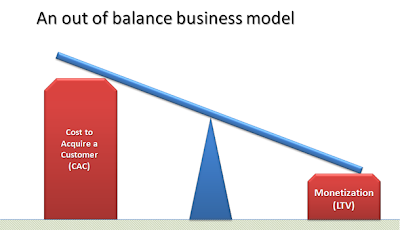
I was prompted to think about these low-cost ideas by a very thoughtful post from David Skok of Matrix Partners, entitled "Startup Killer: The Cost of Customer Acquisition." He points out that most young SaaS companies haven't given nearly enough thought to customer acquisition costs. With a wonderfully simple diagram, he illustrates what happens when those customer acquisition costs (CAC) are wildly out-of-line with the long-term value (LTV) derived from the customer.
Source: David Skok, "for Entrepeneurs" blog
I don't remember much about levers and fulcrums from my high school physics course, but even I can figure out that the Customer Acquisition Costs on the left need to come down. Here's where I'll offer a few ideas.
Besides offering these low-cost tactics, I'll also take this opportunity to reiterate the key prerequisites for any marketing program:
Let me clarify. Actually I do have a few ideas. I'm not sure if they'll work for every software-as-a-service (SaaS) company, but they're at least worth thinking about. Importantly, they're relatively inexpensive to try.
I was prompted to think about these low-cost ideas by a very thoughtful post from David Skok of Matrix Partners, entitled "Startup Killer: The Cost of Customer Acquisition." He points out that most young SaaS companies haven't given nearly enough thought to customer acquisition costs. With a wonderfully simple diagram, he illustrates what happens when those customer acquisition costs (CAC) are wildly out-of-line with the long-term value (LTV) derived from the customer.

Source: David Skok, "for Entrepeneurs" blog
I don't remember much about levers and fulcrums from my high school physics course, but even I can figure out that the Customer Acquisition Costs on the left need to come down. Here's where I'll offer a few ideas.
- Use blogs, email newsletters and other online media to build visibility. If you offer valuable content (read "not overtly promotional"), prospects who are actively looking for solutions will find you. And many of these online media provide a low-cost delivery mechanism for your content. (I don't pay a dime to deliver this blog!) It takes time, but not much money.
- Put all your material online. Print only in small batches and only when absolutely necessary. Save trees and save money.
- Demo your product online. It will make it easy for prospects to see how it works and eliminate some of the need for expensive one-on-one demos. You can build these online demos yourself with tools like Camtasia or work with an outside firm for a more professional look.
- Do local events. Sometimes in-person marketing events can be effective, especially to reach enterprises. It's also a welcome break from the 100% web world. But eschew the big, expensive shows and focus instead on local, targeted gatherings. CCNG, for example, hosts local events for contact center managers.
- Support an online community of customers. Provide a place to share best practices, show tips & tricks, and build loyalty. You'll offload some of your support needs, develop a pool of enthusiastic references, and ease the renewal process.
Besides offering these low-cost tactics, I'll also take this opportunity to reiterate the key prerequisites for any marketing program:
- Set appropriate goals. A sure way to waste money on customer acquisition is to generate more leads than you can handle.
- Measure the cost-effectiveness of every individual program and make adjustments as needed.
- Understand your pipeline. You need to know where deals are getting stuck, so you can make smart choices about where to apply resources.
Wednesday, January 6, 2010
Make it Easy to Deploy
"Some Assembly Required." Three terrifying words for the "screwdriver-challenged." To those moms and dads who may have just lived through the experience, I'm sorry for reviving ugly memories.
What's scary about bikes, dollhouses and the Wii is scary for software-as-a-service (SaaS) solutions, too. The folks subscribing to SaaS solutions do so, in part, to avoid hassles. That includes not just hardware hassles and upgrade hassles, but implementation and deployment hassles, too.
SaaS providers should consider ways to minimize that implementation hassle for their customers. I recently talked to a company selling a SaaS solution to help non-profits manage fund-raising. They've put in place a standard implementation program that they offer along with their subscription. Under the program, a project manager walks the customer through a standard set-up process - migrating donor information, graphic design, automated email set-up, etc. - and holds their hands through the first few months of usage.
The company reports that these implementation services have been received well by customers and removed barriers to selling. It works especially well for organizations that don't have a dedicated resource to manage the system. That lack of a dedicated resource is likely the same reason these organizations were attracted to a SaaS solution in the first place.
This issue refers back to one of my "SaaS Marketing Essentials: Do's and Don'ts," namely "sell the entire service," not just the features, narrowly defined. Besides adding lots of functions, make the solution easy to buy, easy to deploy, and easy to renew. And tout those "easy's" as part of the total value proposition.
By the way, I have no idea what you should do with the handful of nuts, bolts, and washers leftover after assembling that bicycle, but I'd suggest your child wear a helmet and avoid steep hills.
What's scary about bikes, dollhouses and the Wii is scary for software-as-a-service (SaaS) solutions, too. The folks subscribing to SaaS solutions do so, in part, to avoid hassles. That includes not just hardware hassles and upgrade hassles, but implementation and deployment hassles, too.
SaaS providers should consider ways to minimize that implementation hassle for their customers. I recently talked to a company selling a SaaS solution to help non-profits manage fund-raising. They've put in place a standard implementation program that they offer along with their subscription. Under the program, a project manager walks the customer through a standard set-up process - migrating donor information, graphic design, automated email set-up, etc. - and holds their hands through the first few months of usage.
The company reports that these implementation services have been received well by customers and removed barriers to selling. It works especially well for organizations that don't have a dedicated resource to manage the system. That lack of a dedicated resource is likely the same reason these organizations were attracted to a SaaS solution in the first place.
This issue refers back to one of my "SaaS Marketing Essentials: Do's and Don'ts," namely "sell the entire service," not just the features, narrowly defined. Besides adding lots of functions, make the solution easy to buy, easy to deploy, and easy to renew. And tout those "easy's" as part of the total value proposition.
By the way, I have no idea what you should do with the handful of nuts, bolts, and washers leftover after assembling that bicycle, but I'd suggest your child wear a helmet and avoid steep hills.
Wednesday, December 30, 2009
Generating Leads and Cultivating Opportunities
 Now in late December, the field of my neighbor's farm is bare, except for a single row of hardy, but frozen-solid Brussels sprouts stems. In a few weeks, though, my neighbor and his crew will be working inside the greenhouse with a specially-devised planting machine. They pour a large burlap bag full of seeds into the hopper and the machine carefully inserts a single seed into an individual tray compartment. Each compartment is filled with a blend of rich soil, vermiculite and fertilizer, carefully prepared to nurture each seed into a healthy seedling.
In April and May, when I get around to preparing my amateur, backyard plot, I won't bother to scatter a packetful of seeds, most of which won't germinate. Instead, I'll pick up a couple of those trays, which by then will be full of healthy lettuce, tomato and pepper seedlings.
Besides giving me something to look forward to throughout the winter, there's an idea in here that can be helpful for marketers, in particular those marketing software-as-a-service (SaaS) solutions, for whom controlling the cost of customer acquisition is especially important:
Pay attention to cultivation.
It's not enough to gather a passel of leads, like 40-pound bags of seed. You need to carefully cultivate those leads and nourish them into qualified opportunities.
Here are a few ways in which these efforts often go wrong:
- Marketers are measured on "leads," not "qualified opportunities." In other words, they're rewarded for the wrong goal. This often happens because marketing doesn't own the entire process; they generate the leads, but they hand them over to sales for qualification. For this arrangement to work properly, marketing and sales need to share responsibility. That can be difficult.
- The cultivation process is starved. Money is spent on search engine optimization, pay-per-click, PR, advertising, etc., all in the interests of attracting a prospect's initial attention and gathering their name and contact information - in other words, generating a lead. (Per item 1, that's what marketing is often asked to do.) The follow-on process - cultivating that lead into a qualified opportunity -often isn't given enough resource or attention.
- The cultivation process skips a critical step. Undifferentiated leads are often handed off to sales without adequate cultivation. This is an extremely expensive way to qualify leads, particularly when the solution is sold through a direct sales force. To manage customer acquisition costs, companies need to build in a more cost-effective qualification step into the process.
- The cultivation process is too short. The leads aren't given enough time to germinate. I heard a story recently about a SaaS provider that extended their free trial period from 30 days to 60 days. The result was a substantial increase in the number of "tryers" converting to buyers. Apparently, the extra 30 days was enough time for the prospective customers to gain enough experience and confidence to actually subscribe. Reminds me of that Supremes' standard, "You Can't Hurry Love."
Subscribe to:
Posts (Atom)